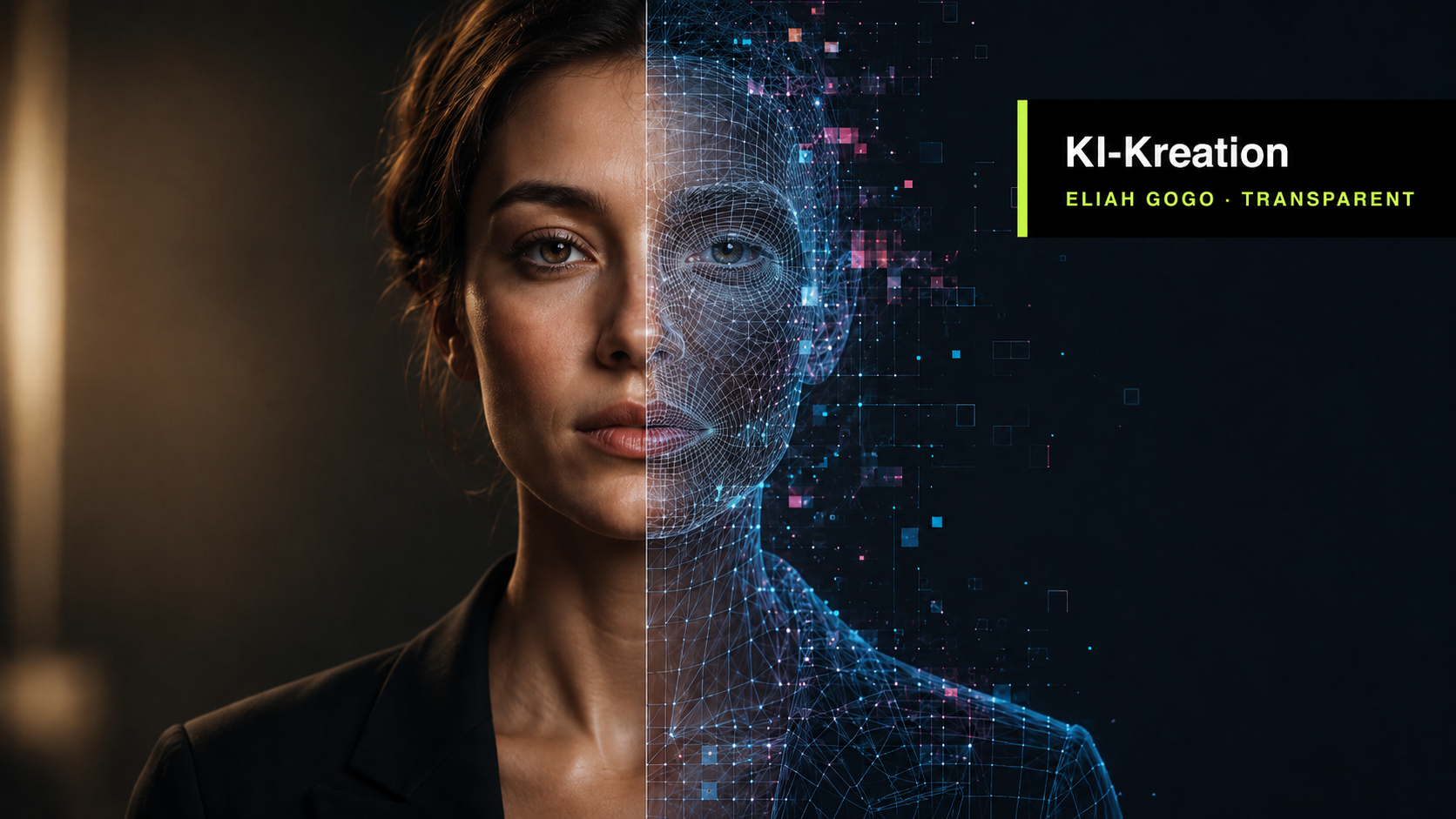
From 2 August 2026, the EU AI Act requires AI content to be labelled. What this means for posters, social media, music and videos – explained simply by Eliah GOGO.
We work with AI every day. Images for posters, music production, digital stage worlds, social media assets – AI is part of our method. And that is exactly why many clients are currently asking us the same question: “Do I actually have to label this?” The short answer: from 2 August 2026, in many cases, yes. The good news: it is much simpler than it sounds. Here is everything you need to know as an event organiser, city, cultural institution or brand.
What changes on 2 August 2026?
On this date, the transparency obligations under Article 50 of the EU Artificial Intelligence Regulation (AI Act) become binding.
The idea behind it is simple: people should be able to tell whether what they see or hear is real – or was generated by an AI. Important to understand: the obligation applies to whoever publishes. So not just to us as a studio, but
also to the event organiser, the city, the theatre or the company that puts up an AI-generated poster or posts a video. Violations can lead to fines – and unclear labelling can also result in warning letters under competition law.
Transparency is not a bureaucratic issue. Being open about how a work was created builds trust – and that is what communication is all about.
Mirko I Eliah GOGO
The simplest rule: could it be mistaken for real? Not every AI image needs a warning sign. The law distinguishes by the potential to deceive. This results in a simple traffic-light system:
Label (mandatory):
Photorealistic AI content that could be mistaken for a real recording – people, objects, buildings, entire scenes. Also real photos whose content has been altered with AI (background swapped, people added or removed). The notice must be visible directly on the image – a hidden sentence in the legal notice is not enough here.
Notice recommended:
Recognisably artistic or illustrative motifs – poster art, comic style, surreal scenes, historical figures in a
modern interpretation. Nobody is pretending anything here. For artistic works, a discreet notice is enough, for example in the credits or the imprint area of the poster.
Not mandatory:
AI as a pure tool. A real photo with lettering added by AI
(“Save the Date”), a crop, a colour correction – the image content remains authentic, so nothing needs to be labelled here.
Does this only apply to images? No. Article 50 covers more than most people think: Video: AI-generated videos need a
visible label in the image or a notice at the beginning. A sentence such as “This footage was created with AI” is enough.
Audio & music: Synthetic voices, voice clones and AI-generated music are also covered. The label can be added in the description – for example in the streaming profile, the track description or the show notes.
Texts: There is an important exemption here: AI-generated texts do not need to be labelled if a human has reviewed them editorially and takes responsibility. That is how we work anyway – no text leaves our studio without
human editing.
Chatbots: Anyone operating a chatbot or voice agent must make sure that users
realise they are talking to an AI. And what about content that is already online?
The law does not apply retroactively. Nobody has to rework their archive or re-edit old
videos. But two things make sense: update descriptions – on YouTube, the label “Altered or synthetic content” can be added afterwards in the video details; on Spotify & co., add it to the description. Ten minutes of work, zero residual risk.
Reuse = new publication: anyone who posts or reprints an old AI motif again after 2 August is publishing it anew – and then labels it too.
Does every single image really need a label? (The most common misconception)
We often hear this worry: “I use almost nothing but AI images – do I now have to stick a notice on every photo? That will ruin my feed and my website.” The good news: no, you do not.
The law requires the notice to be clearly recognisable and accessible as soon as someone sees the content – but not that it has to be in the image itself. According to the EU guidelines, the notice can be given in writing, as an icon or as text next to the content. It is basically like copyright: you do not write the photo credit across every photo either, but in a suitable place next to it.
Social media: A notice in the caption is enough. An “Image AI-generated” in the caption fulfils the obligation – you do not have to burn a label into every feed image. The visible label thus becomes a style decision: use it where you want it to make a deliberate impact, and leave it out where it spoils the look.
Website: A single, clearly visible collective notice can cover an entire section – for example a discreet line on the gallery or in the page footer: “All images on this page are AI-generated.” You do not have to mark every photo individually.
There are two things to keep in mind: the notice must be reasonably easy to find – visible on the page, not just hidden deep in the legal notice. And the obligation mainly targets photorealistic motifs that could be mistaken for a real recording (rooms, buildings, scenes). For clearly artistic or stylised motifs, it is weaker anyway.
In short: one well-placed notice per context is enough – a visible sentence on the website, a note in the caption. No need for a graveyard of watermarked images.
How we handle it at Eliah GOGO
We decided not to wait and not to calculate what we can still get away with: from
now on, we label everything that was created substantially with AI.
On posters as a small note “Image AI-generated” in the imprint block. In social media captions. In video descriptions. In the credits of our music productions.
Why? Because we have nothing to hide. Our works start with an idea, a story, an
attitude – AI is the tool we use to realise them. Anyone who communicates this openly will have no compliance worries from August and is already gaining something far more important today: credibility.
For our clients, this means in concrete terms: with every project, we deliver the right labelling as well – correctly placed, discreetly designed, legally sound. You do not have to worry about a thing.
Final thought
The labelling obligation is not an obstacle to creative work with AI. It is an invitation
to show confidently how modern production works today. The exciting question is not whether a work was created with AI – but whether it tells a story that makes people pause.
Planning a project and unsure what needs to be labelled? Write to us – we will sort it out in five minutes.
Note: This article summarises the transparency obligations under Art. 50 of the EU Artificial Intelligence Regulation (Regulation (EU) 2024/1689) in plain language and does not replace legal advice. As of June 2026.