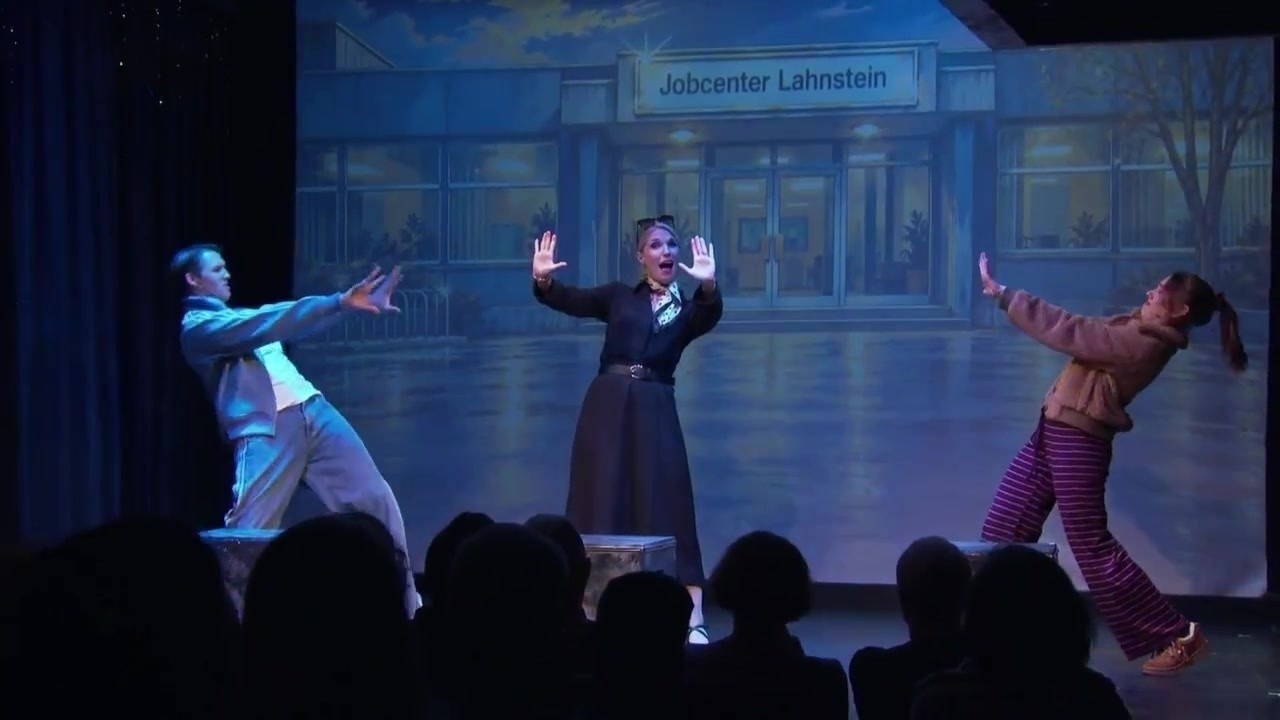
When small theatres work with tight budgets, the savings are usually made in the same places: design, advertising, set design, music production and digital presence.
Most of the money goes where it has to go – into the staff and the essentials needed to get the show on stage. That makes sense. Live performance depends on human talent. But it also means that many productions never reach the level of visibility, polish and visual ambition they actually deserve.
That was the challenge behind “Lahnrock Airways”, an original musical production for the municipal theatre in Lahnstein. The question was simple:
How can a small theatre production look much bigger – without increasing the budget and without cutting a single job?
Our approach
For Lahnrock Airways, we developed an AI-assisted production model designed to raise production quality across several areas while fully preserving the human core of the project. That is the crucial difference. We did not use AI to replace writers, performers or crew members.
All lyrics, melodies and the libretto were originally written by Mirko Klos.
AI was used as a production tool – not to reduce staff, but to achieve more with a limited budget.
The goal was not to save money by cutting jobs.
The goal was to make professional quality more affordable.Mirko I Eliah GOGO
Where the savings came from
The biggest savings were made in the areas that tend to become very expensive very quickly in smaller productions:
- Music production
AI-assisted workflows helped cut production costs by up to 60 % while enabling a significantly higher-quality result. - Trailers and promotional material
Avatar-based placeholders made it possible to create promotional material before the final cast was set, which allowed earlier and more professional communication. - Digital set design
Instead of relying solely on physical stage solutions, the production integrated digital stage environments and avatar characters as part of the visual concept. - Website and overall visibility
AI-assisted workflows helped create a stronger digital presence, better campaign materials and a more professional public image than small productions can usually afford.
What actually changed
The savings didn’t come from lower artistic ambition. They came from making higher production quality possible at lower cost. That is very different from the usual narrative about AI. All too often, AI is only discussed in the context of replacing jobs. In this case it did something else: it helped make stronger music, better visuals, earlier promotion and a more ambitious production world achievable on a smaller budget. And all of this without replacing a single job.
Why this matters for smaller theatres
For smaller cultural institutions, the opportunity is not to become cheaper in a way that looks cheap. The real opportunity is to bridge the gap between limited budgets and high creative standards.
That means:
- better visibility
- stronger fundraising potential
- more ambitious productions
- better promotional material
- higher perceived production value
In other words: theatres don’t need AI to become less human.
They need it to become more visible, more professional and more competitive.
Final thought
Lahnrock Airways showed that AI can strengthen live culture when it is used with the right intention. Not by replacing authorship. Not by pushing people out. But by helping smaller productions achieve more with what they already have. And for a cultural sector under growing budget pressure, that could be one of the most valuable uses of AI.